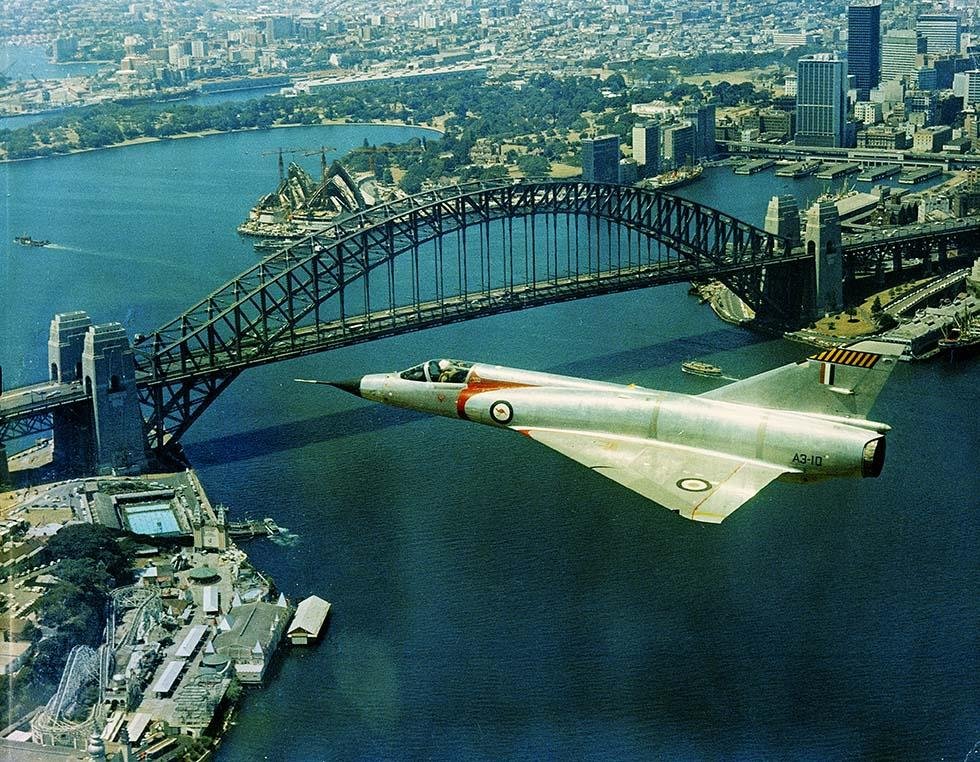
The Mirage IIIO was the Royal Australian Air Force’s first supersonic fighter, serving with the RAAF from the delivery of the first aircraft on 9 April 1963 until its retirement in September 1988, when it was replaced by the F/A-18 Hornet.
In the late 1950s, Australia had still not chosen a new fighter to replace the ageing and outdated CA-27 Avon Sabre, an Australian-modified and built version of the American F-86 Sabre. Australia needed a new, modern fighter that was on par with the new NATO fighters of the day.
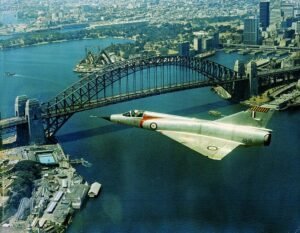
The logic of air defence at the time called for a fast interceptor that could move quickly to engage waves of nuclear bombers. Australia seriously considered the F-104 Starfighter for this role. Although the Starfighter was nicknamed the “Widowmaker” by some countries that adopted it as their interceptor, it was a strong contender, with a top speed of Mach 2 and a service ceiling of 73,000 feet.
However, Australia needed more than just an interceptor. It required a fighter-bomber that could perform all roles, as it was intended to be the RAAF’s only frontline fighter. It also needed an aircraft capable of ground attack and one that could travel much longer distances than the F-104’s limited combat radius of 680 km (420 miles). Australia’s vast geography demanded a greater strike range. The Mirage III offered a combat radius of approximately 1,200 km (750 miles), almost double that of the Starfighter.
Another lesson learned by the RAAF was that Australia tended to operate its aircraft well beyond their expected service life. Because of this, it was important to manufacture many, if not all, replacement parts domestically. As aircraft aged and fewer remained in service worldwide, spare parts became increasingly difficult and expensive to obtain. The RAAF had already kept the CA-27 in service for around ten years longer than originally planned, so it understood this problem well. By concentrating on manufacturing the components that wore out most frequently, Australia could ensure a reliable supply while reducing long-term costs.
This made the manufacturing agreement with Dassault a major factor in selecting the Mirage. Australia secured the right to build the aircraft under licence. The Government Aircraft Factories would assemble the aircraft from parts supplied by Dassault, while the Commonwealth Aircraft Corporation would manufacture the wings, tail sections and engines.
The first Australian Mirage was built in France by Dassault and carried the designation Mirage IIIE. It was fitted with a Rolls-Royce Avon Mk 67 afterburning engine at the request of the Australian Government, as Australia already had experience manufacturing other versions of the Avon turbojet engine for its Canberra bombers. Flight testing showed that the Avon outperformed the French Atar 9C, particularly during take-off. However, the Avon installation proved too expensive, and it was decided to retain the Atar 9C, the standard engine fitted to French Mirages. This unique IIIE was the only aircraft of its type ever built and was named City of Hobart.
The designation for all subsequent Australian-built Mirages was IIIO. The first 49 aircraft were IIIO(F) fighter-interceptor models, while the remaining 51 were IIIO(A) fighter-bombers. All of the F models were later converted to the A standard. The only significant differences between the A and F models were the paint scheme, hardpoints and the Doppler radar.
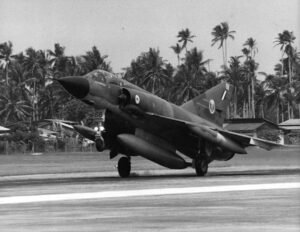
Unlike aircraft such as the F-14 Tomcat or the F-111, the Mirage did not have a variable-geometry wing that provided excellent handling at both high and low speeds. Straight or swept wings generally perform better at lower speeds, while delta wings excel at speeds above Mach 1. Because the Mirage relied solely on its large delta wing, its low-speed handling was less forgiving. This resulted in a relatively high landing speed, a longer stopping distance and the need to conduct low-level ground attack missions at relatively high speeds.
Some Mirage pilots have recalled that the only time they ever flew at Mach 2 was during their conversion course, and that they never approached that speed again during operational flying. During the early 1960s, intercontinental ballistic missiles began replacing waves of manned bombers as the primary means of delivering nuclear weapons, reducing the need for high-speed interceptor aircraft.
In 1967, the Mirage proved itself in combat as a fighter-bomber. The Israeli Air Force had also purchased the aircraft and used it to great effect during the Six-Day War. Israeli Mirages destroyed numerous ground targets while also engaging Hawker Hunters, MiG-21s, MiG-19s and MiG-17s in aerial combat.
Australian Mirages never fired a shot in anger, although a total of 40 aircraft were lost in accidents during their service. The fleet was retired in 1988 when the F/A-18 Hornet entered RAAF service. With the exception of several aircraft preserved in museums around Australia, all remaining Australian Mirages were sold to the Pakistan Air Force in 1990.
Author: Daniel Harper