Controversial, complicated and frighteningly capable
Australia ordered 24 General Dynamics F-111Cs in 1963 to replace the RAAF’s ageing Canberra bombers. After almost a decade of delays, technical problems and political controversy, the first aircraft finally arrived at RAAF Base Amberley on 1 June 1973. The F-111C would go on to serve Australia for 37 years and become one of the most distinctive and formidable aircraft in Royal Australian Air Force history. Few aircraft in Australian military history have generated as much controversy, excitement and affection as the General Dynamics F-111C. Australia ordered 24 of them in 1963, but the first six did not arrive at RAAF Base Amberley until 1 June 1973. By then Australia had seen six prime ministers, a succession of defence ministers, enormous cost increases and years of argument over whether the aircraft would ever actually be delivered. When it finally arrived, though, Australia possessed something extraordinary. The F-111 could fly at more than twice the speed of sound, travel enormous distances, penetrate enemy territory at extremely low altitude in darkness and bad weather, and carry a weapons load that transformed the Royal Australian Air Force’s strike capability. Its American nickname became the Aardvark literally meaning “earth pig” in Afrikaans but Australians simply called it the Pig. It could get down into the weeds, fly frighteningly fast and find its way through terrain that other bombers would have avoided. It would remain in Australian service for 37 years.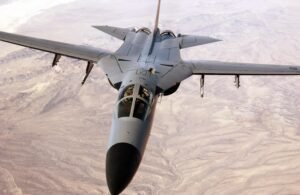
Australia needed something very different
To understand why Australia was prepared to take such a huge gamble on an aircraft that had not even flown when it was ordered, you have to look at what was happening around Australia in the late 1950s and early 1960s. In the early 1960s, Indonesia had moved closer to the Soviet Union and began taking delivery of MiG fighters and the Tupolev Tu-16 Badger, a twin-engined, long-range strategic bomber that considerably increased Indonesia’s ability to threaten targets in northern Australia and the wider region. Indonesia was also involved in a confrontation with the Dutch over Dutch New Guinea and, from 1963, the Indonesia-Malaysia Confrontation. The region had become a very real part of the Cold War and Australia had reason to be concerned. At the same time, Britain was beginning to reduce its military presence east of Suez, the Vietnam War was developing, and instability across Southeast Asia made Australia’s strategic position look considerably less comfortable than it had a decade earlier. Australia was looking for a modern long-range strike aircraft to replace the ageing English Electric Canberra bomber. What the RAAF wanted was ambitious. It needed a fast, supersonic aircraft with very long range that could accurately navigate across vast areas of open ocean and the difficult terrain of the region. It needed to operate in all weather, during both day and night, and have modern electronic countermeasures that could help it penetrate sophisticated land- and sea-based air defence networks. It needed to fly fast and low, get underneath enemy radar, hit its targets accurately and get out again just as quickly. Australia wanted an aircraft with the range of a strategic bomber, but one that could survive against increasingly sophisticated air defences. And those air defences were changing the rules. On 1 May 1960, an American U-2 reconnaissance aircraft flown by Francis Gary Powers was shot down over the Soviet Union by a surface-to-air missile. The idea that an aircraft could simply fly so high that nobody could reach it suddenly looked considerably less convincing. Future strike aircraft would increasingly have to go the other way — low, fast and underneath much of the enemy’s radar coverage. That requirement would strongly influence both Britain’s TSR-2 and America’s F-111.Choosing Australia’s next bomber
Australia examined a number of possible Canberra replacements. At various stages, aircraft such as Britain’s V-bombers, the North American A-5 Vigilante, the Boeing B-47 Stratojet and France’s Mirage IV entered the discussion. Two particularly important contenders emerged: Britain’s highly advanced BAC TSR-2 and the American aircraft being developed under the TFX Tactical Fighter Experimental program. The TSR-2 promised extraordinary performance, but Australia had serious concerns about its cost and, importantly, whether the British Government remained sufficiently committed to the program. Those concerns were justified. Britain ultimately cancelled the TSR-2 in 1965 and that left the American TFX as the more realistic choice. Australia made an extraordinary decision and, in 1963, ordered 24 aircraft before the F-111 had even entered production service. Australia would become the only foreign nation ever to operate the F-111.One aircraft for the Air Force and Navy
The F-111 itself had come from an equally ambitious American idea. US Secretary of Defense Robert McNamara wanted the United States Air Force and United States Navy to operate versions of the same basic aircraft. The Air Force wanted a long-range strike aircraft capable of approximately Mach 2.5 at altitude and supersonic flight at low level, while the Navy wanted a long-endurance fleet interceptor capable of operating from aircraft carriers. Trying to make one aircraft to satisfy both requirements became the TFX program. General Dynamics eventually won the competition, despite controversy surrounding the selection, with the Air Force version becoming the F-111A and the proposed naval version the F-111B. The Navy eventually abandoned the F-111B and went in another direction, ultimately leading to the Grumman F-14 Tomcat. Imagine if Secretary McNamara had got his way. We might have seen Maverick and Goose hitting the skies in Top Gun in a completely different aircraft, and the F-111 may have become as famous worldwide as the Tomcat. Some of the work done to accommodate the Navy would, however, indirectly benefit Australia.Australia’s unusual F-111C
The Australian F-111C was not simply an American F-111A with Australian markings. It combined features from different members of the F-111 family. Most noticeably, the F-111C received the longer-span wings associated with the naval F-111B, along with strengthened landing gear to cope with the additional weight. The longer wings provided additional fuel capacity and therefore greater range — something particularly useful for a country the size of Australia and its surrounding area of operations. With its wings fully forward, the F-111 had much better low-speed lift, allowing it to operate from shorter runways. As speed increased, the wings could progressively swept rearwards, reducing drag and allowing the aircraft to fly supersonically. It was not the first aircraft ever to experiment with variable-sweep wings — aircraft such as the Bell X-5 had already demonstrated the principle but the F-111 became the world’s first production operational combat aircraft to make variable geometry a central part of its design. The result was an aircraft capable of around Mach 2.5 at altitude and approximately Mach 1.2 at low altitude.Flying underneath the radar
Speed alone was not what made the F-111 revolutionary. Its real party trick was its Terrain Following Radar, or TFR. Rather than simply showing the crew the terrain ahead, the radar could be coupled to the aircraft’s automatic flight-control system. The crew selected a terrain-clearance height, and the aircraft could automatically climb and descend, following the shape of the ground beneath it. In Australian service, the selectable clearances included very low levels measured in only hundreds of feet. That meant an F-111 could fly at night, in cloud and at high speed with the crew unable to see the terrain outside. That capability came with obvious risks. Low-level night attacks were among the most demanding forms of military aviation. Australia lost eight F-111s during its years operating the type, and several fatal accidents occurred during night or low-level flying. The aircraft could do extraordinary things. But it demanded an enormous amount from its crews.No ordinary flight controls
The variable wings also created some unusual engineering problems. Conventional ailerons on a wing whose sweep angle constantly changed would have been difficult to arrange, so the F-111 did not use traditional ailerons in the usual fashion. Instead, spoilers on the wings and the aircraft’s large all-moving horizontal tail surfaces contributed to roll control. The two tail surfaces could move together for pitch or differentially to help roll the aircraft. The engine intakes were another complicated piece of engineering. A jet engine does not want supersonic air simply rushing directly into its compressor. At very high speeds, the airflow must be controlled and slowed before reaching the engine. The F-111 used sophisticated variable inlet geometry to manage this airflow. At lower speeds, however, the engines could require additional air. Different F-111 inlet versions employed movable inlet components and auxiliary openings to supply the engines while still controlling airflow during high-speed flight. Even something as apparently simple as slowing the aircraft could be unconventional. The large main undercarriage door could also contribute to aerodynamic breaking when opened. Almost everywhere you looked, the F-111 was complicated and, in the 1960s, much of this technology was being attempted on an operational aircraft for the first time.An ejection seat wasn’t enough
One of the most distinctive F-111 features was what happened when everything went seriously wrong.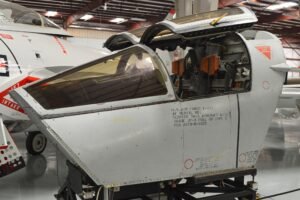
What if the pilot couldn’t fly?
That was not left entirely to chance either. The F-111’s right-hand crew member was the navigator/weapons systems officer and was not trained to independently fly the aircraft through a normal mission. But navigators were trained to recover the F-111 from an abnormal attitude if the pilot became incapacitated. Former RAAF navigator Phil McDonald has described training in which the pilot would deliberately put the aircraft into an unusual attitude, sometimes after practice bombing at Evans Head. The navigator would then have to regain control, recover the aircraft to a safe altitude and place it in a condition from which the crew escape module could be used. The aim was not to teach the navigator how to land the F-111. It was to make sure that if the pilot became unable to fly, the navigator could at least save them both.Then the wheels began to come off the program
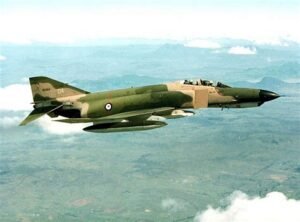
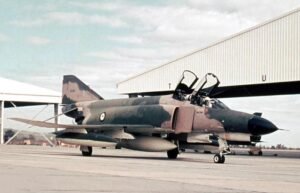
Australia’s gamble soon became a political nightmare. The first Australian crews travelled to the United States for training in the late 1960s expecting their new aircraft to follow, but serious structural problems emerged. During the F-111’s development there had already been troubling combat experience. Six F-111As were sent to Southeast Asia in 1968 for operational evaluation. Three aircraft were lost during the deployment, with investigations indicating technical or structural problems rather than enemy action in the losses. Then came an even more serious warning. On 22 December 1969, an F-111A suffered catastrophic structural failure during a routine training flight when its port wing separated from the aircraft, killing both crew members. The failure was traced to a pre-existing manufacturing defect in a critical wing pivot fitting. Concerns also surrounded the aircraft’s massive wing carry-through structure, which carried the enormous loads created by its variable-sweep wings. For Australia, the effect was devastating. The aircraft it had already paid for could not safely be accepted. The Australian F-111s remained in the United States while a painstaking structural testing and rectification program was undertaken. The aircraft had effectively become an enormously expensive fleet Australia owned but could not use. Meanwhile, Australia still needed a strike aircraft.The Phantom fills the gap
Almost ten years after the order
On 1 June 1973, the first six F-111Cs arrived at RAAF Base Amberley. It had been almost ten years since Australia committed itself to the aircraft. The 24 aircraft were ferried in four groups of six from the United States to Australia. After years of political controversy, engineering problems and uncertainty, the RAAF finally had the aircraft it had ordered back in 1963.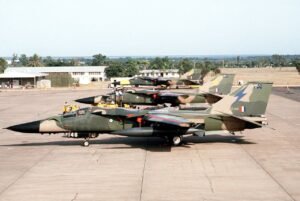
A bomber without modern guided weapons
There was one problem with Australia’s enormously sophisticated new strike aircraft. For much of its early life, its weapons did not match its capabilities. The original RAAF F-111 primarily carried conventional unguided bombs. Low-level attack could still increase accuracy because the aircraft could approach a target extremely precisely and release its weapons from a known position. But Australia did not initially possess the range of precision-guided weapons that would later make the F-111 such a formidable strike platform. That began changing during the 1980s.Pave Tack transforms the RAAF F-111C
One of the most important upgrades in the F-111’s Australian career was Pave Tack. The AN/AVQ-26 Pave Tack system incorporated a forward-looking infrared sensor, laser rangefinder and target designator. Rather than seeing the world as a conventional colour television image, the infrared sensor detected differences in thermal energy. The navigator could identify a target at night, designate it with a laser and guide a laser-guided bomb onto it. Australia approved the Pave Tack project in 1980. Testing followed during the first half of the decade, with Australian modification work proceeding from 1985. The pod itself was fitted in the aircraft’s weapons bay. When required, the sensor turret rotated down beneath the aircraft. When it was no longer needed, it could retract back into the fuselage. Pave Tack brought the Australian F-111 properly into the precision-guided weapons age. The same general upgrade period also added the ability to employ weapons such as the AGM-84 Harpoon anti-ship missile, giving the Pig a formidable maritime strike capability. That was particularly important for an island continent surrounded by enormous expanses of ocean.Franklin Dam — a very unusual mission
One of the F-111’s most controversial Australian missions did not involve attacking anybody. It involved Tasmania. In 1983, the new Hawke Government was locked in a constitutional battle with the Tasmanian Government over construction of the Franklin hydro-electric scheme. The Commonwealth wanted photographic evidence of continuing work at the site for its legal action so on 7 April, an RAAF Mirage III was sent to photograph the area, but the mission produced unsatisfactory results, and its low passes were anything but discreet. The following day, an RF-111C reconnaissance aircraft conducted a high-altitude photographic mission. This time it got photographs. Unfortunately for the government, news that Australian military aircraft had been used for surveillance inside Australia created a political storm. Attorney-General Gareth Evans, who had initiated the request, acquired the nickname “Biggles”. The images became associated with the Commonwealth’s case against Tasmania, which ultimately reached the High Court.F-111 Deseal/Reseal — the dangerous job nobody saw
The F-111 story also has a much darker chapter. Its enormous internal fuel capacity depended on extensive integral fuel tanks inside the aircraft structure. Maintaining those tanks required personnel to enter extremely confined spaces and remove and replace sealants. Beginning in the 1970s, RAAF personnel carried out what became known as the F-111 Deseal/Reseal programs. Workers were exposed to a cocktail of fuel, solvents, sealants and other chemicals in extremely difficult working conditions. Years later, serious concerns emerged about the health of those personnel. A formal Board of Inquiry was held in 2000, followed by the Study of Health Outcomes in Aircraft Maintenance Personnel. The Commonwealth subsequently established healthcare, compensation and support arrangements for eligible personnel involved in F-111 fuel tank work. The issue remains significant enough that Department of Veterans’ Affairs programs for affected F-111 workers continue today. It is an important part of the aircraft’s history. The F-111’s extraordinary capability came not only from pilots and navigators flying it, but from thousands of maintainers keeping one of the world’s most complicated aircraft operational. Some of them paid a very high price.The F-111C Avionics Upgrade Program
By the early 1990s, Australia faced another problem. While the basic F-111 airframe remained highly capable, its avionics were becoming old. The solution was the Avionics Upgrade Program. Much of the aircraft’s ageing analogue equipment was replaced by modern digital systems. The upgraded aircraft received new mission computers, digital data buses, a digital stores management system, modern navigation equipment and upgraded attack and terrain-following systems. It effectively gave a 1960s airframe a new electronic brain and that presented a training problem. The old simulator was no longer good enough.Building Australia’s F-111 Tactical Mission Simulator
This is perhaps one of the least-known chapters in Australia’s F-111 story. The Avionics Upgrade Program required an equally sophisticated new training system. Australian company Wormald Technology was contracted to develop a new F-111C Tactical Mission Simulator. Initially there was the possibility of upgrading the existing simulator. But attempting to continually modify an old system had obvious limitations. A fundamentally new simulator would give the RAAF something that could itself be upgraded as the F-111 evolved. The project became particularly ambitious because Wormald had not previously designed and built an aircraft simulator of this complexity. The new simulator was designed and constructed in Australia and incorporated an extensive simulated tactical environment and huge quantities of digital terrain information. It was eventually powered by more than 40 computer processors and had to reproduce not simply what an F-111 cockpit looked like, but what its attack radar, Terrain Following Radar, electronic warfare systems, weapons and Pave Tack infrared sensor actually did. That was a very different problem from making a simulator that simply taught somebody how to take off and land.Building Australia in a computer
One of the hardest parts was the Digital Radar Landmass Simulation system. Terrain Following Radar did not show the world like a television camera. The simulator therefore needed to create believable radar responses from mountains, valleys, coastlines and other terrain. Its database had to contain known terrain heights and features so the simulated F-111 would respond as the actual aircraft would. The simulator’s terrain database ultimately represented around 200,000 square nautical miles, and creating it proved extremely difficult. During the development period, crews needed to begin conversion training on the upgraded aircraft before all elements of the simulator were fully mature. That produced the extraordinary situation described by members of the simulator team in the Red Eye documentary. Crews could train on the portions of the system that were available during the day while engineers and programmers continued working on it at night. Then they would do it again the next day. The simulator was installed at Amberley in 1997 in an interim configuration, but Commonwealth final acceptance did not occur until December 2000. Wormald’s Australian simulation business was subsequently acquired by Thomson-CSF, which became Thales. The simulator eventually became an extraordinary training tool. Crews could practice situations far too dangerous to deliberately attempt in the actual aircraft.500 knots at 200 feet
A simulator was particularly valuable because some F-111 tactics bordered on the unbelievable. The aircraft had been designed to exploit very low-level flight. At night, an F-111 could travel at around 500 knots only a few hundred feet above the terrain using the TFR and autopilot. Precision-guided weapon attacks could involve approaching the target low and fast before performing a high-G pull-up or toss-bombing maneuver. The weapon could be released while the aircraft climbed, effectively throwing it ahead. With a laser-guided bomb, the navigator could then continue designating the target with Pave Tack while the aircraft manoeuvred away. Training material for F-111 crews described automatic terrain-following descents down to around 200 feet and toss deliveries of precision-guided weapons at night. It was the sort of training where a simulator was worth considerably more than its purchase price.The simulator helps save a real aircraft
In July 2006, that simulator demonstrated its value in a very public way. A RAAF F-111 took off from Amberley and its left main wheel separated from the aircraft after the landing gear was retracted. The crew now had an aircraft that could fly perfectly well but could not land normally. They remained airborne for around three hours, burning fuel while teams on the ground used simulators to test possible approaches and landing techniques. Eventually, the crew brought the F-111 back to Amberley. They caught the runway arresting cable and made a controlled landing, with the damaged undercarriage producing a dramatic shower of sparks as the aircraft came to a stop. Pilot Peter Komar and navigator Luke Warner both walked away. The incident was an extraordinary demonstration of why sophisticated simulation mattered.The Popeye arrives
The F-111’s weapons continued to improve towards the end of its career. One of the most significant additions was the AGM-142, derived from the Israeli Rafael Popeye missile and known in US service as Have Nap. Unlike a conventional bomb, it allowed the F-111 to attack a target from well outside the immediate target area. The weapon combined a large warhead with television or imaging-infrared terminal guidance and a data link that allowed the crew to guide it onto the target. Depending on the version and mission conditions, the Popeye family offered a stand-off range measured in tens of kilometres, commonly quoted at around 80 kilometres. That dramatically changed the F-111’s tactical options. Instead of having to fly directly over an increasingly well-defended target, the Pig could launch from a considerable distance away. By this stage, the aircraft Australia had ordered in 1963 bore only a passing resemblance electronically and in weapons capability to the one that had finally arrived in 1973.Alone with the Pig
Then Australia inherited another problem. The USAF retired its remaining F-111Fs in 1996 and its EF-111 electronic-warfare aircraft in 1998. Australia was now the only country in the world still flying the type. There was no enormous American fleet supporting spare parts, engineering knowledge, upgrades and maintenance anymore. Australia now had to sustain an exceptionally complicated and expensive aircraft largely by itself. Australian defence scientists, engineers, maintainers and industry kept the F-111 viable far beyond what many had expected. But it could not go on forever.The beginning of the end
In 2003, the Australian Government announced that the F-111 would be retired. At that stage, the long-term replacement was expected to centre on the F-35A Lightning II, but the F-35 would not arrive soon enough. Australia therefore purchased 24 Boeing F/A-18F Super Hornets as an interim strike capability. Unlike the F-4 Phantom lease three decades earlier, the Super Hornets would not merely be borrowed and returned. They became a permanent part of the RAAF and the Pig’s days were now numbered.The RAAF F-111 retires — 3 December 2010
On 3 December 2010, the F-111’s Australian career finally ended. Six aircraft flew in formation over Brisbane and the Gold Coast before returning to Amberley. One aircraft performed the famous dump and burn, in which fuel was dumped behind the aircraft and ignited by the afterburners to create an enormous plume of flame. Then, one by one, the F-111s landed and the last to touch down was A8-125. It was the same aircraft that had led the first six F-111Cs into Amberley on 1 June 1973. Thirty-seven years later, it became the last operational F-111 anywhere in the world to land. There could hardly have been a more appropriate aircraft to close the story.What happened to them?
Not every Australian F-111 survived retirement. Thirteen aircraft were preserved for museums and heritage displays, along with a number of crew escape modules. Other airframes were dismantled. Twenty-three F-111 fuselages that were not selected for preservation were eventually buried in Queensland, while other components were disposed of separately. The disposal attracted considerable attention, but the aircraft contained materials that made ordinary scrapping difficult, and there were also security and disposal requirements surrounding American military technology. For an aircraft that had once represented the absolute cutting edge of aviation, seeing F-111 fuselages being buried was an unusual final chapter.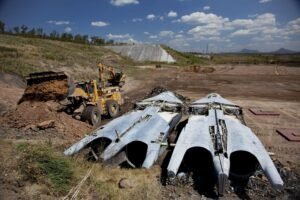
The Pig
What made the F-111 remarkable was the way it brought so many advanced technologies together in one operational aircraft. It became the first production variable-sweep combat aircraft, was among the earliest combat aircraft powered by afterburning turbofans, pioneered automatic terrain-following flight and placed both crew members inside a self-contained escape module. It could fly at around Mach 2.5 high above the ground, or it could fly through complete darkness only a few hundred feet above it. It could carry conventional bombs, laser-guided weapons, Harpoon anti-ship missiles and, later, long-range stand-off weapons. Australia kept developing it long after the country that designed it had stopped flying it and for 37 years, if Australia needed to send a message that something very fast, very heavily armed and capable of travelling a very long way could arrive in the middle of the night at extremely low altitude, there was one aircraft sitting at Amberley that could do it.1/48 Scale Australian F-111C available on Amazon
HobbyBoss 1/48 Scale Australian F-111C Pig 1/48 Airplane Plastic Model Kit
As an Amazon Associate Khaki and Green earns from qualifying purchases