The McDonnell Douglas A-4G Skyhawk: Australia’s Pocket-Sized Carrier Fighter
There is something about the Douglas A-4 Skyhawk that seems to contradict the normal development of military aircraft.
Fighter and attack aircraft generally become larger, heavier, more complicated and more expensive as they evolve. The Skyhawk went in almost the opposite direction.
It was small, light and relatively simple. It wasn’t supersonic and it didn’t have the size or technological sophistication of aircraft such as the F-4 Phantom. Yet the little Skyhawk became one of the great combat aircraft designs of the post-war period.
It fought in Vietnam, the Middle East and the Falklands. It flew with the US Navy’s Blue Angels, became an aggressor aircraft used to train generations of fighter pilots, served aboard some surprisingly small aircraft carriers and remained relevant long after many of its contemporaries had disappeared. And who could forget the scenes in Top Gun where Viper, flying an A-4, gives Maverick and Goose a run for their money?
For 17 years, from 1967 until 1984, it also served with the Royal Australian Navy. Australia called its version the A-4G Skyhawk, and for a small aircraft operating from a relatively small aircraft carrier, it gave the RAN an impressive combination of strike, fleet defence and even air-to-air refuelling capabilities.
But perhaps the strangest part of the Australian Skyhawk story came after we got rid of them. Australia sold its surviving Skyhawks to New Zealand, only to later have New Zealand Skyhawks return to HMAS Albatross to provide the Australian Navy with some of the very capabilities the aircraft had previously provided when they belonged to us.
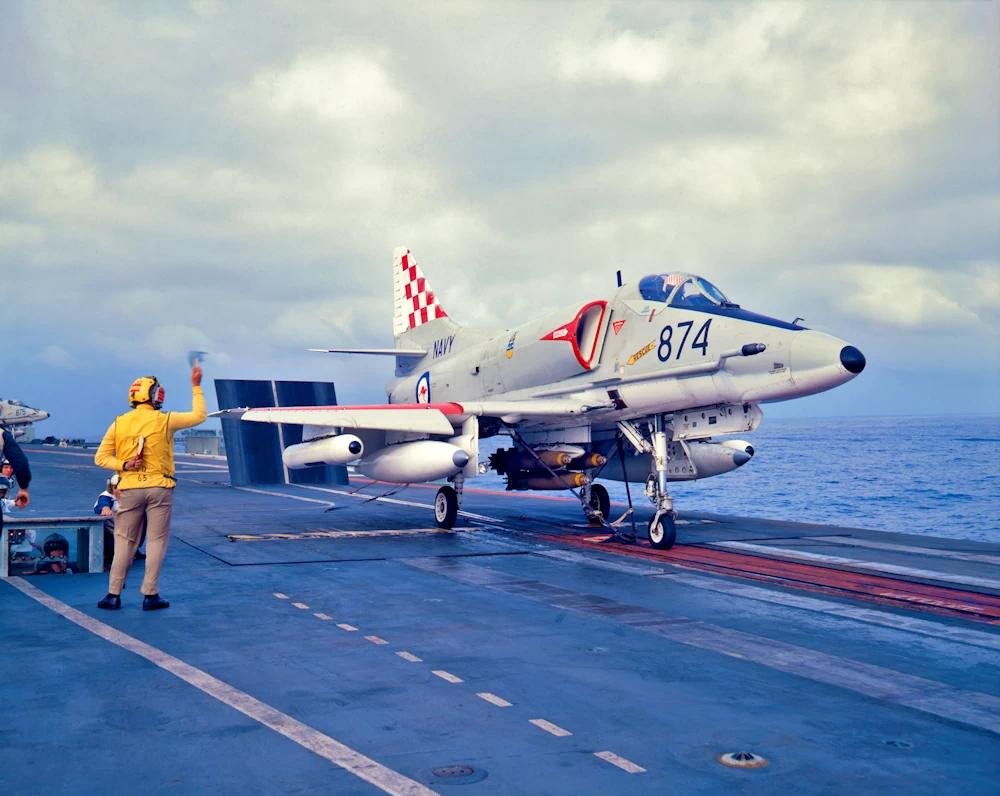
A Royal Australian Navy A-4G Skyhawk positioned on the catapult aboard the aircraft carrier HMAS Melbourne.
Designed to be small
The Skyhawk was designed in the early 1950s by Douglas Aircraft Company’s legendary designer Ed Heinemann.
The US Navy wanted a new jet-powered attack aircraft to replace the piston-engine Douglas A-1 Skyraider, another classic aircraft designed at the end of the Second World War that went on to serve extensively in the ground-attack role during the Korean and Vietnam wars.
Heinemann was concerned by a trend already becoming obvious in military aviation. Every new combat aircraft seemed to be getting heavier, more complicated and more expensive. Rapid changes in technology also meant pilots were regularly converting to new aircraft, while ground crews had to keep pace with increasingly complex systems. His answer was to make the new aircraft as simple and light as possible, and the result was remarkable. That same broad philosophy of keeping a combat aircraft light, capable and affordable would reappear in later designs such as the F-16.
The prototype Skyhawk first flew on 22 June 1954. Testing and development followed before the type entered US Navy service in 1956. Eventually, 2,960 Skyhawks would be produced during a production run lasting about 25 years.
It was a tiny aircraft by fighter standards. Its wingspan was only 27 feet 6 inches, or about 8.4 metres. That small wing had another advantage aboard an aircraft carrier, it did not need to fold. This helped keep weight and maintenance down, while the wing’s main spars were machined from a single forging spanning almost the entire width of the aircraft. The result was a very strong structure capable of carrying an impressive weapons load while still allowing the Skyhawk to remain highly manoeuvrable.
The Skyhawk’s automatic leading-edge slats were another example of the same thinking. Instead of using complicated hydraulic actuators, the slats deployed automatically through gravity and aerodynamic forces as the aircraft slowed. It was a simple and effective system, although asymmetric slat movement could make the aircraft demanding in some conditions.
Even the landing gear was designed around saving weight. The main undercarriage did not have to retract completely inside the wing structure, allowing the wing itself to remain relatively thin and light. The long undercarriage also left plenty of room underneath the little aircraft for weapons and external fuel tanks.
The same philosophy continued at the back. Instead of adding numerous large access panels to reach the engine, the rear section of the aircraft could be removed, exposing the engine for removal and maintenance. It was an aircraft designed around the idea that anything unnecessary simply didn’t belong there.
The Skyhawk picked up several nicknames during its career, including Scooter, Tinker Toy, Bantam Bomber and probably the best of them all, Heinemann’s Hot Rod. Among Australian naval aviators another unofficial description appeared: ‘The Professional’s Preference.’ That probably tells you something about both the aircraft and the people who flew it. In experienced hands the Skyhawk was a serious adversary, but with a less capable pilot it could also be a demanding aircraft to fly.
Small aircraft, serious performance
The Skyhawk was not supersonic. By the standards of the 1960s, when Mach 2 fighters such as the Mirage III and F-4 Phantom were appearing, that might have made the aircraft seem outdated but it wasn’t.
The Skyhawk’s strength was never outright speed. It was small, agile, extremely responsive and capable of carrying an extraordinary amount of ordnance for its size.
The Australian A-4G was powered by a Pratt & Whitney J52-P-8A turbojet producing approximately 9,300 pounds of thrust. Maximum speed was around 670 mph — roughly 1,080 km/h — and service ceiling was about 40,000 feet.
The aircraft was armed with two Colt Mk 12 20 mm cannon, one mounted in each wing root, with 100 rounds per gun. Five external stations allowed the later Skyhawks to carry bombs, rockets, missiles, external fuel tanks and other equipment.
The A-4 also had another trick that would become particularly important to the Royal Australian Navy. It could turn another Skyhawk into a tanker.
The little fighter that could become a tanker
The Skyhawk became closely associated with the buddy-buddy refuelling system.
A Skyhawk carrying a refuelling store under its centreline could unreel a hose and drogue behind the aircraft. Another Skyhawk could then plug its refuelling probe into the drogue and receive fuel. It meant a carrier did not necessarily require a large dedicated tanker aircraft. One of its own attack aircraft could become the tanker, and for a navy operating a carrier as small as HMAS Melbourne, that was an extremely useful capability.
In Nick Anderson’s Plane Tales podcast, he tells a remarkable story from his time as a British exchange officer with the RAAF while exercising in New Zealand with RNZAF Skyhawks. He recalls seeing a photograph of a four-ship New Zealand Skyhawk formation inverted halfway through a barrel roll while one of the aircraft remained connected to the lead aircraft’s buddy-refuelling drogue. Whether as a demonstration of formation discipline, aircraft handling or both, it says a lot about what the Skyhawk could do in skilled hands.
Here is where the Australian Skyhawk story becomes particularly interesting. At the time, the Royal Australian Air Force did not possess a dedicated operational air-to-air tanker fleet.
The RAAF eventually converted Boeing 707 transports into tankers to support its F/A-18 Hornets, with the air-to-air refuelling capability entering service around 1990–91. That was years after the RAN had retired its Skyhawks. For a period, therefore, those little naval Skyhawks gave the Australian Defence Force an organic air-to-air refuelling capability that the much larger RAAF could not provide itself.
The Australian A-4G
Australia initially ordered ten Skyhawks in October 1965. The first batch consisted of eight single-seat A-4Gs and two two-seat TA-4G trainers. The Australian aircraft were closely related to the US Navy’s A-4F, but there were important differences.
The A-4F had the distinctive avionics hump behind the cockpit that makes later American Skyhawks immediately recognisable. The Australian aircraft did without much of the equipment contained in that installation and consequently retained the cleaner lines of the earlier Skyhawks.
The A-4G could carry the AIM-9B Sidewinder heat-seeking air-to-air missile, giving a small attack aircraft a useful fleet-defence capability. The aircraft retained its conventional strike capability as well, including unguided bombs and rockets. What the Australian Skyhawks did not possess was a sophisticated guided air-to-ground weapon capability. For attacking ground and surface targets, the RAN was still largely relying on the pilot putting an unguided bomb or rocket where it needed to go. That required skill — a lot of it.
Learning to operate from HMAS Melbourne
The first Australian Skyhawks arrived in 1967, but putting a new high-performance jet aboard Australia’s ageing aircraft carrier was not as simple as flying them out to the ship. HMAS Melbourne required modifications before the Skyhawks and the Navy’s new Grumman S-2 Trackers could properly operate from her.
805 Squadron recommissioned on 10 January 1968, but the modifications to Melbourne meant Australian pilots initially had to complete their carrier qualification elsewhere. The opportunity arrived when the British aircraft carrier HMS Hermes operated off the Australian coast. In late October 1968, RAN Skyhawks made their first arrested landings and catapult launches from Hermes.
It was not until the following year that the aircraft began regular operations aboard HMAS Melbourne and Australia once again possessed a credible carrier-borne fighter and strike capability.
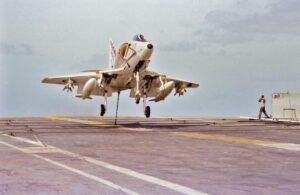
A Royal Australian Navy A-4G Skyhawk landing aboard the aircraft carrier HMAS Melbourne.
A Skyhawk night attack
One account from Lieutenant Commander Fred Lane, who commanded 805 Squadron, gives an idea of what the aircraft and its pilots were capable of. During a 1969 exercise, a Grumman S-2 Tracker located surface ships after sunset. The Tracker transmitted their position and remained clear of the target while helping to guide the Skyhawk formation in. The formation approached at low level, with Skyhawks dropping flares to illuminate the ships below. The remainder of the formation then attacked.
It is a wonderful example of what Australia’s carrier air group could do at the time. A Tracker finding the enemy fleet, Skyhawks being launched from Melbourne, a low-level night approach and the target being illuminated for the attacking aircraft and all of it from a carrier that had originally been laid down during the Second World War.
Twenty Australian Skyhawks
Australia decided to increase the fleet with another ten aircraft. The second batch consisted of former US Navy A-4F and TA-4F aircraft that were rebuilt to Australian A-4G/TA-4G standard. This brought the total Australian acquisition to 20 Skyhawks.
Of those 20 aircraft, ten were lost in accidents during Australian service. That is an extraordinary attrition rate when viewed today, but it also reflects the environment in which these aircraft operated. High military-aircraft accident rates were far more common in that era. The RAAF, for example, lost 42 of its 116 Mirage III aircraft during their service.
The pilots were flying high-performance single-engine jets at low level, practising air combat and weapons delivery and launching from and landing on a relatively small aircraft carrier at sea. The Skyhawk may have been simple by combat-aircraft standards but flying one operationally certainly wasn’t.
A little aircraft that could embarrass fighters
Perhaps one of the best indications of just how capable the Skyhawk remained comes not from Australian naval service, but from New Zealand.
In Nick Anderson’s Plane Tales podcast, he recalls deploying to New Zealand and operating F/A-18s against RNZAF A-4 Skyhawks. On paper, it should not have been much of a contest.
Anderson describes exercises in which the A-4s could use New Zealand’s terrain to hide at extremely low level. The Hornets could pass overhead without detecting them, after which the Skyhawks would climb out behind the Australian fighters and put themselves into a firing position.
The Australians discovered that beating a Skyhawk flown by somebody who really knew how to use it wasn’t necessarily easy.
From Vietnam to the Falklands
US Navy and Marine Corps A-4s flew extensively during the Vietnam War, where the aircraft became one of the principal naval strike aircraft of the conflict. Israel also used Skyhawks heavily in combat, particularly during the War of Attrition and the 1973 Yom Kippur War.
Then, in 1982, the little aircraft went to war against the Royal Navy. Argentina operated several variants of the Skyhawk, and Argentine A-4s flew extremely low-level attacks against British ships during the Falklands War.
They suffered severe losses against Sea Harriers, surface-to-air missiles and anti-aircraft fire. But they also demonstrated exactly why the Skyhawk had survived for so long. Flying at extremely low level over the South Atlantic, Argentine pilots pressed attacks against modern British warships using largely conventional unguided bombs, sinking or badly damaging several ships. The basic aircraft design was almost 30 years old at the time.
As we will see, the Falklands War would also have a completely unexpected effect on the future of Australian naval aviation.
The End of Australian Carrier Aviation – But That Wasn’t the Plan
When HMAS Melbourne was decommissioned in 1982, it brought the Skyhawk’s career at sea with the Royal Australian Navy to an end but at the time, this was not necessarily supposed to be the end of Australian aircraft carriers.
For years Australia had been considering how to replace the ageing Melbourne, and by the early 1980s the government had settled on a remarkably interesting solution. Australia was going to buy the British aircraft carrier HMS Invincible off the British.
Invincible was a very different ship to Melbourne. Commissioned into the Royal Navy in 1980, she was a modern light aircraft carrier designed around helicopters and the remarkable Sea Harrier, which could take off over the ship’s distinctive ski-jump and land vertically.
In February 1982 the Australian Government announced that arrangements had been made to purchase Invincible from Britain, with the ship intended to enter Australian service as HMAS Australia. Had the plan gone ahead, Australian naval aviation would have looked very different from the A-4G Skyhawk era.
Australia was also considering what aircraft could operate from its future carrier, and one of the obvious possibilities was the Sea Harrier. The Sea Harrier did not need the steam catapult and arrestor-wire system used to launch and recover the Skyhawks aboard Melbourne. Its ability to make short take-offs and vertical landings meant that a relatively small carrier such as Invincible could still operate a useful force of fast jets.
Then history intervened. On 2 April 1982, Argentina invaded the Falkland Islands and Britain suddenly needed Invincible. Instead of preparing to transfer to Australia, the carrier sailed for the South Atlantic as part of the British task force sent to retake the islands and the Sea Harrier went to war.
The Falklands War demonstrated just how valuable the combination of Invincible, and the Sea Harrier could be. Royal Navy Sea Harriers flew combat air patrols over the British fleet and fought Argentine aircraft, including the A-4 Skyhawk.
There is an interesting connection here. Australia was preparing to retire its Skyhawks and potentially replace its carrier capability with a ship operating Sea Harriers, while on the other side of the world Sea Harriers were fighting Argentine Skyhawks in one of the most famous air campaigns of the post-war period.
The Falklands War interrupted the sale, and afterwards the British Government decided it needed to retain Invincible. The Fraser Government continued examining other carrier options, but the political situation in Australia was also changing. After the Fraser Government lost office in March 1983, the incoming Hawke Government decided that HMAS Melbourne would not be replaced and the carrier project was abandoned.
With that decision went the requirement for a new generation of Australian naval fighters. There would be no HMAS Australia, no Australian Sea Harrier fleet and no replacement for the Skyhawk aboard an Australian aircraft carrier.
The Royal Australian Navy’s era of fixed-wing carrier aviation was over. The remaining A-4Gs continued operating from HMAS Albatross with 724 Squadron, carrying out fleet-support and training work before finally being retired from Australian service on 30 June 1984.
Ironically, the Navy would soon discover that while it had given up its aircraft carrier, it had not given up its need for many of the jobs the Skyhawks had performed. That eventually led to the rather extraordinary situation where Australia sold its remaining Skyhawks to New Zealand and then paid to have Skyhawks come back.
We sold them – then needed them back
This may be the most fascinating part of the whole story.
After selling its surviving Skyhawks to New Zealand, Australia discovered that the disappearance of the aircraft had also removed useful capabilities that the Navy still required.
The RAAF now had the new F/A-18 Hornet but using front-line Hornets to provide all the Navy’s fleet-support requirements was expensive and competed with the RAAF’s own operational and training demands.
Then Defence Minister Kim Beazley explained the problem during a 60 Minutes report: ‘The F-18 is too costly an aircraft to provide fleet support to the extent that is required by the Navy. The resources are just not there to do it.’ The Navy still needed aircraft that could simulate attacks against its ships, provide fighter-like targets and support the training of ship crews and weapons operators.
Some fleet-support work, including target towing, was increasingly being performed by civilian aircraft such as Lear jets. These were jobs the Skyhawks had once performed. The situation created an extraordinary piece of Australian defence history. Australia had sold its remaining Skyhawks to New Zealand, and now we needed some of that capability back. The solution was not to buy the aircraft back, but eventually to bring New Zealand Skyhawks to Australia through an arrangement that included the aircraft and their crews.
No. 2 Squadron RNZAF was subsequently based at HMAS Albatross at Nowra, flying Skyhawks in support of Australian Defence Force training. Among their jobs was attacking Australian warships during exercises and providing realistic fast-jet training for Australian forces. In the same 60 Minutes report, Defence Minister Kim Beazley said the initial cost of equipping HMAS Albatross to accommodate the Skyhawks would be about $6 million, with operating costs of about $5 million a year. He argued this was much cheaper than owning and maintaining Australian fighter aircraft solely for the fleet-support role.
The Royal Australian Navy had sold its Skyhawks, and now Skyhawks were back over the Australian coast teaching Australian sailors how to fight aircraft. There is a certain irony in that. The RNZAF detachment at Nowra continued until January 2002, when No. 2 Squadron ceased operations there and returned to New Zealand as the RNZAF fast-jet force was being disbanded.
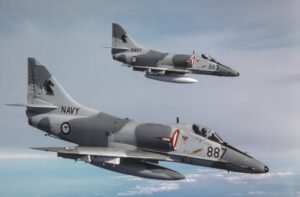
Royal Australian Navy A-4G Skyhawks flying in formation. U.S. Navy photograph, public domain.
Nearly half a century in military service
The prototype Skyhawk had first flown in 1954, and the first Australian Skyhawks arrived in 1967. The RAN retired them in 1984, while New Zealand continued operating Skyhawks until 2001.
Elsewhere, the design survived even longer, including in upgraded forms and in the aggressor and contract-training world. An aircraft conceived when the Korean War had only just ended remained useful well into an age of digital radar, beyond-visual-range missiles and fly-by-wire fighters. That is a remarkable achievement.
The Skyhawk wasn’t designed to win a technology competition. It was designed to be small, light, maintainable and capable of carrying weapons from an aircraft carrier. It didn’t need to fly at Mach 2. It simply needed to do its job, and it did that job exceptionally well.
For Australia, the A-4G also represents something we have not possessed since: a fast jet operated by the Royal Australian Navy from an Australian aircraft carrier. There was plenty of debate about retaining a carrier capability, but one argument was that the RAAF’s F-111C could perform the long-range strike role better than either the Skyhawk or the proposed Harrier. The F-111C was an all-weather strike aircraft with a sophisticated navigation and bombing system, which the Skyhawk did not have. It could also fly very long distances without refuelling. But a land-based strike aircraft and a carrier-based fighter are not the same capability. The F-111 could project strike power a long way from Australia, but it could not travel with a naval task group and provide fighter cover wherever the ships went. Beyond the reach of land-based aircraft, that required carrier-operated jets.
The sight of an A-4G being catapulted from the deck of HMAS Melbourne is therefore more than an interesting photograph from Australian aviation history. It represents an entirely different Australian naval capability.
Twenty Skyhawks were acquired, ten were lost, and the survivors went to New Zealand. Years later, Skyhawks returned to Australian skies because the Navy still needed the kind of training they could provide.
For a little aircraft designed in the early 1950s, Heinemann’s Hot Rod certainly left a very long shadow.
Mcdonnell Douglas A-4C Skyhawk available on Amazon
Highly-detailed replica of the A-4C Skyhawk, a carrier-capable attack aircraft used by the United States Navy and Marine Corps in the 1960s and 1970s.