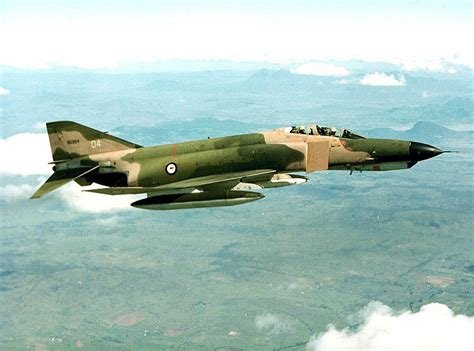
McDonnell Douglas F-4E Phantom: The RAAF’s Interim Fighter While Waiting for the F-111C
Few aircraft have earned the legendary reputation of the McDonnell Douglas F-4 Phantom II.
Loud, smoky and immensely powerful, the Phantom served with air forces around the world and became one of the defining combat aircraft of the Cold War.
Although the F-4E Phantom only served with the Royal Australian Air Force for just under three years, from 1970 until 1973, its impact on the RAAF was enormous. It wasn’t simply a temporary replacement for the delayed F-111C. It introduced Australian aircrew and ground personnel to an entirely new generation of supersonic combat aviation and helped prepare No. 82 Wing for the aircraft it had been waiting years to receive.
Why Australia Needed a New Strike Aircraft
In the early 1960s, Indonesia had moved closer to the Soviet Union and began taking delivery of the Tupolev Tu-16 Badger, a twin-engine, long-range strategic bomber. Indonesia was also involved in a confrontation with the Dutch over Dutch New Guinea and, from 1963, the Indonesia-Malaysia Confrontation.
The region had become a very real part of the Cold War and Australia had reason to be concerned.
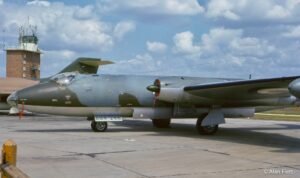
Australia was already looking for a modern long-range strike aircraft to replace the ageing English Electric Canberra bomber.
What the RAAF wanted was ambitious.
It needed a fast, supersonic aircraft with very long range that could accurately navigate across vast areas of open ocean and the difficult terrain of our region.
It needed to operate in all weather, during both day and night, and have modern electronic countermeasures that could help it penetrate sophisticated land- and sea-based air defence networks. It needed to fly fast and low, get underneath enemy radar, hit its target accurately and get out again just as quickly.
The aircraft the Australian Government chose in 1963 was the General Dynamics F-111.
The F-111C Delays
Australia ordered the F-111 before the aircraft had even entered operational service, and there were considerable delays in getting this completely new and very advanced aircraft to deliver everything that had been promised.
Australia also requested changes to its aircraft, resulting in the unique F-111C variant.
RAAF crews began training in the United States on available F-111A aircraft, but development problems continued. Of particular concern were structural problems involving the F-111’s wing carry-through box.
This was especially serious because the F-111’s revolutionary variable-geometry wings placed enormous loads through this central structure.
Until the problems could be properly understood and rectified, the Australian Government would not accept delivery of its aircraft.
The F-111C was now delayed indefinitely and the RAAF needed another solution—and it needed one fast.
Enter the McDonnell Douglas F-4E Phantom
As a stopgap measure, an agreement was reached with the United States in 1970 to lease 24 brand-new F-4E Phantoms.
Other aircraft, including the British Blackburn Buccaneer and the American Grumman A-6 Intruder, had been considered as possible interim solutions, but the Phantom was selected.
The United States would provide training and ground equipment, as well as air-to-air refuelling support should the Australian Phantoms need to be deployed operationally. This was important because the F-4E did not possess the enormous unrefuelled strategic reach Australia expected from the F-111C.
Australian crews were already in the United States preparing for the F-111, so personnel could quickly be redirected towards the Phantom program.
What happened next was, in my opinion, one of the great achievements of the RAAF during this period.
From Lease Agreement to Operational Aircraft in Six Months
Australian pilots and navigators trained at different locations in the United States before coming together as crews.
The aircraft were then ferried to Australia in an operation involving a mixture of Australian and American personnel. Additional training would continue back in Australia, with United States Air Force instructors helping bring the RAAF squadrons up to full operational strength.
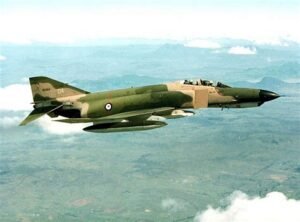
It took only around six months from the lease agreement being announced to having the F-4E Phantom in service with the RAAF in Australia.
The speed at which this happened can partly be attributed to the fact that the RAAF had already been preparing for the arrival of the F-111C. Much of the infrastructure required to accommodate a large, modern supersonic aircraft was therefore already being put into place at RAAF Base Amberley.
Even so, I think you have to give enormous credit to the RAAF and the quality of its personnel for pulling this off in such a short time.
Procedures needed to be written, aircrew trained, ground personnel prepared and maintenance crews taught how to look after a completely unfamiliar and highly sophisticated aircraft.
Very few air forces could introduce a completely new supersonic combat aircraft that quickly.
I also find it interesting, and almost comical, that an interim aircraft had to be acquired near the beginning of the F-111’s Australian career and another interim aircraft was required at the end.
When the F-111 was finally retired in 2010, delays associated with Australia’s future F-35A Lightning II meant the RAAF had already acquired the F/A-18F Super Hornet to ensure Australia retained its strike capability.
The Super Hornet had never been part of the original plan either but that is another story.
First Impressions of the F-4E Phantom
The F-4 Phantom remains an iconic aircraft to this day.
It is a battle-proven airframe that earned its place in history as an awesome fighter and strike aircraft. In the United States it served with the Air Force, Navy and Marine Corps and became one of the most recognisable military aircraft of its generation.
The RAAF’s F-4E Phantoms wowed Australian audiences during the RAAF’s 50th anniversary celebrations in 1971. Air displays were held around the country and the big, fast and smoky Phantom was naturally a crowd-pleaser.
And there really isn’t another jet that looks quite like it.
The Australian War Memorial has some online footage of the RAAF Phantoms. See this link to watch the footage. https://www.awm.gov.au/collection/F02805
Why Does the F-4 Phantom Look Like That?
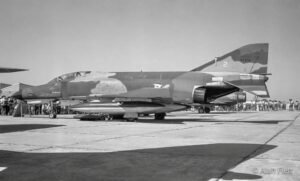
The Phantom has a collection of strange aerodynamic features that together give the aircraft its unmistakable appearance.
Look at the empennage—which is aviation geek talk for the aircraft’s tail section—and one of the first things you notice is the sharply downward-angled, all-moving stabilators.
The Phantom also has its famous upturned outer wing panels.
During the aircraft’s development, additional dihedral was required to improve lateral stability. Rather than completely redesigning the central wing structure, the designers gave the outer wing panels approximately 12 degrees of dihedral, producing the required aerodynamic effect.
The result was one of the Phantom’s most distinctive features.
Then there are those huge splitter plates sitting in front of the engine intakes. They form part of the complex system used to manage airflow and keep the turbulent boundary layer away from the engine intakes.
And then there is the nose.
The big, chunky nose of the Phantom was necessary to accommodate the powerful radar that was central to the aircraft’s original development as an all-weather interceptor. Earlier Phantom prototypes looked quite different because their smaller radar installations did not require the large nose that would become so characteristic of production Phantoms.
Put all these features together the upturned outer wings, downward-angled tailplanes, enormous intakes, big radar nose and two smoky General Electric J79 engines and there is simply no mistaking an F-4 Phantom.
What Was the RAAF F-4E Phantom Like to Fly?
Former RAAF Wing Commander Lance Halvorson recalled his experiences flying the Phantom and described it as a fantastic air-superiority interceptor.
One thing that particularly stood out was its acceleration.
The F-4E had enormous power from its two J79 turbojet engines and represented a huge performance increase over the aircraft RAAF bomber crews had previously operated.
But the Phantom was much more than simply a fast aircraft.
Its radar, avionics, weapons systems and two-man crew environment introduced the RAAF to technology and operating procedures far beyond those of the Canberra.
That experience would become extremely valuable when the F-111C finally arrived.
What Weapons Did the RAAF F-4E Phantom Carry?
Unlike some earlier versions of the Phantom, the F-4E had an internally mounted 20 mm M61A1 Vulcan cannon in the nose.
The Vulcan was capable of an extremely high rate of fire around 6,000 rounds per minute at its maximum setting. The RAAF used a lower rate of approximately 4,500 rounds per minute. With only around 640 rounds available, even at the reduced rate the ammunition disappeared very quickly.
For air-to-air combat, the Phantom could carry radar-guided AIM-7 Sparrow missiles for longer-range engagements and heat-seeking AIM-9 Sidewinder missiles for shorter-range combat.
In the strike role, RAAF Phantom crews trained extensively with conventional general-purpose bombs. A typical heavy strike configuration could include up to twelve 500 lb bombs along with Sidewinder missiles for self-defence.
RAAF crews practised several methods of weapons delivery, including conventional dive bombing, skip bombing, level radar bombing and dive-toss.
Dive-toss was particularly interesting.
The crew visually acquired the target and the aircraft’s systems provided radar ranging information. The weapons computer could then calculate the correct release point and automatically release the bombs as the pilot commenced the pull-out.
It was sophisticated compared with what the RAAF had been accustomed to but it also highlighted one of the Phantom’s major limitations in the Australian role.
The crew still needed to be able to see the target.
Why the Phantom Wasn’t an F-111
This is probably the most important point to understand about the RAAF’s F-4E Phantom.
The Phantom was a brilliant aircraft, but it wasn’t the aircraft Australia had originally set out to buy.
Lance Halvorson explained that the Phantom’s radar gave it an excellent all-weather air-to-air capability. When it came to attacking targets on the ground, however, it could not provide the capability Australia expected from the F-111.
Its radar could provide ranging information to a ground target, and systems such as dive-toss could calculate the weapons release point, but the Phantom crew still needed to visually identify the target.
Bad weather or darkness could therefore become a major limitation.
The F-111C was a completely different proposition.
Its sophisticated navigation, attack and terrain-following systems were designed to allow the aircraft to penetrate hostile territory at very low altitude, at high speed and in poor weather or darkness.
That was the capability Australia had wanted from the beginning.
The Phantom also lacked the enormous range required for Australia’s strategic strike requirements without relying on air-to-air refuelling.
The F-4E was a superb fighter-bomber and interceptor.
But as great as the Phantom was, it simply wasn’t an F-111.
A69-7234: A Major Repair Achievement for the RAAF
The first major F-4E accident in Australian service occurred on 19 October 1970 and involved aircraft A69-7234 at RAAF Base Amberley.
The aircraft suffered an equipment failure that left the crew without normal nose-wheel steering and anti-skid braking.
An arrested landing was attempted using the Phantom’s tail hook and arrestor gear across the runway. The landing went badly wrong and the aircraft was severely damaged.
The damage was extensive enough that repairing the Phantom became a major engineering undertaking for the RAAF.
A69-7234 required around 18,750 man-hours of work during its rebuild, including major structural repairs and replacement of the right wing.
The aircraft flew again in September 1971.
For an air force that had only just received the Phantom, repairing such a badly damaged and sophisticated aircraft was a considerable achievement and another example of just how quickly Australian personnel had adapted to the F-4E.
The Loss of RAAF Phantom A69-7203 at Evans Head
Sadly, Australia’s short period of Phantom operations was not without tragedy.
On 16 June 1971, Squadron Leader Stuart Fisher and Flight Lieutenant Robert Waring were killed when F-4E Phantom A69-7203 crashed into the sea near the Evans Head bombing range on the New South Wales coast.
The aircraft had been taking part in a night exercise.
Following the bombing portion of the mission, A69-7203 was attempting to re-join the other aircraft when contact was lost.
A search began and floating wreckage was located in the ocean the following morning.
The accident investigation found no evidence that a medical condition affecting either crew member had contributed to the accident, and the aircraft had been considered serviceable for the flight apart from minor recorded issues that investigators did not find had contributed to the crash.
The loss of A69-7203, Squadron Leader Fisher and Flight Lieutenant Waring was the only fatal accident and only complete aircraft loss during the RAAF’s brief period operating the Phantom.
The Arrival of the F-111C and the End of the RAAF Phantom
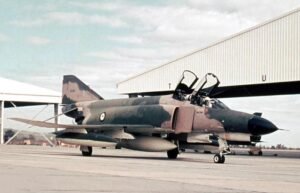
By 1973, the problems that had prevented Australia from accepting the F-111C had finally been resolved and the aircraft began arriving at Amberley.
The United States offered Australia the opportunity to retain the F-4Es, and it isn’t difficult to understand why there was some enthusiasm within the RAAF for keeping them.
But there was an obvious question.
What would Australia do with them?
The RAAF now had the aircraft it had waited a decade for in the F-111C, giving Australia one of the most advanced long-range strike aircraft in the world.
It also had the Mirage IIIO providing its fighter capability.
The Phantom could certainly have provided another very capable fighter and ground-attack force, but operating additional Phantom squadrons would require personnel, maintenance resources and considerable funding.
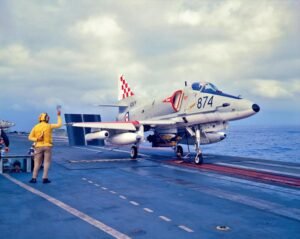
Australia also had another very capable ground-attack aircraft in service with the Royal Australian Navy—the Douglas A-4G Skyhawk.
As good as the Phantom was, keeping it was difficult to justify.
Ultimately, the decision was made to return the aircraft to the United States, bringing Australia’s brief but memorable period operating the McDonnell Douglas F-4E Phantom to an end.
The last RAAF Phantom flight took place in June 1973.
What Happened to Australia’s F-4 Phantoms?
The story didn’t end when the Phantoms left Australia.
Most of the former RAAF aircraft were eventually converted into F-4G Wild Weasel aircraft, specialising in the suppression of enemy air defences.
Some of these aircraft went on to serve operationally many years after leaving Australia, including during the 1991 Gulf War.
Their careers were extended even further when many were later converted into QF-4 unmanned or remotely controlled target aircraft.
This meant that many of the Phantoms that once carried Australian crews ultimately ended their lives as aerial targets.
Unfortunately, no genuine former RAAF-operated Phantom survives intact today.
The F-4E displayed by the RAAF Museum and painted to represent 69-7208 is actually a former USAF aircraft, 67-0237. It carries the identity of 69-7208 because that aircraft flew the final Phantom sortie in RAAF service.
The RAAF F-4E Phantom’s Legacy
The Phantom was never intended to become Australia’s long-term strike aircraft, yet it proved to be far more than a temporary stopgap.
It introduced the RAAF to the speed, avionics, weapons systems, maintenance requirements and operational philosophy of a new generation of combat aircraft. It allowed No. 82 Wing to gain valuable experience while Australia waited for the troubled F-111C program to finally deliver the aircraft it had promised.
Perhaps one of the most impressive parts of the whole story is just how quickly the RAAF did it.
Within months, Australian pilots, navigators, ground crews and maintenance personnel had gone from preparing for one sophisticated American combat aircraft to operating an entirely different one on the other side of the world.
Today, the Phantom’s time in Australian service is often overshadowed by the aircraft that followed it.
That’s understandable.
The F-111C would serve Australia for 37 years and become one of the most recognisable aircraft ever operated by the RAAF.
The Phantom was here for less than three.
But for those three remarkable years, the F-4E Phantom stood at the forefront of Australian air power.
And for many aviation enthusiasts including myself it remains one of the most charismatic military aircraft ever built.
Those distinctive upturned wings, downward-sloping tailplanes, big radar nose, smoky J79 engines and blistering acceleration make the Phantom instantly recognisable more than half a century later.
It may only have been Australia’s interim aircraft, but what an interim aircraft it was.
F-4 Phantom model on Amazon
If you're interested in the F-4 Phantom. This 1:100 scale die-cast F-4 Phantom II model features the famous VF-84 “Jolly Rogers” markings and comes with a display stand. While it isn’t an Australian RAAF F-4E, it’s a good-looking display model for Phantom enthusiasts.
As an Amazon Associate Khaki and Green earns from qualifying purchases