Military Machines, Equipment, Stories and History

Fighter jet articles

RAAF F-111C: Why Australia Kept “The Pig” Flying for 37 Years

Controversial, complicated and frighteningly capable Australia ordered 24 General Dynamics F-111Cs in 1963 to replace the RAAF’s ageing Canberra bombers. After almost a decade of delays, technical problems and political controversy, the first aircraft finally arrived at RAAF Base Amberley on 1 June 1973. The F-111C would go on to serve Australia for 37 years and become one of the most distinctive and formidable aircraft in Royal Australian Air Force history. Few aircraft in Australian military history have generated as much controversy, excitement and affection as the General Dynamics F-111C. Australia ordered 24 of them in 1963, but the first six did not arrive at RAAF Base Amberley
Read More
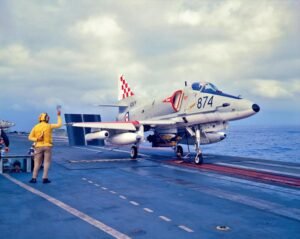
Royal Australian Navy A-4G Skyhawk on the catapult aboard HMAS Melbourne

The McDonnell Douglas A-4G Skyhawk: Australia’s Pocket-Sized Carrier Fighter

There is something about the Douglas A-4 Skyhawk that seems to contradict the normal development of military aircraft. Fighter and attack aircraft generally become larger, heavier, more complicated and more expensive as they evolve. The Skyhawk went in almost the opposite direction. It was small, light and relatively simple. It wasn’t supersonic and it didn’t have the size or technological sophistication of aircraft such as the F-4 Phantom. Yet the little Skyhawk became one of the great combat aircraft designs of the post-war period. It fought in Vietnam, the Middle East and the Falklands. It flew with the US Navy’s Blue Angels, became an aggressor aircraft used to

Read More
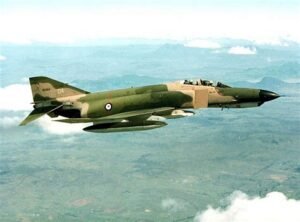
RAAF F-4E Phantom in flight during Australian service

RAAF F-4E Phantom – Australia’s Stopgap Fighter

  McDonnell Douglas F-4E Phantom: The RAAF’s Interim Fighter While Waiting for the F-111C Few aircraft have earned the legendary reputation of the McDonnell Douglas F-4 Phantom II. Loud, smoky and immensely powerful, the Phantom served with air forces around the world and became one of the defining combat aircraft of the Cold War. Although the F-4E Phantom only served with the Royal Australian Air Force for just under three years, from 1970 until 1973, its impact on the RAAF was enormous. It wasn’t simply a temporary replacement for the delayed F-111C. It introduced Australian aircrew and ground personnel to an entirely new generation of supersonic combat aviation

Read More
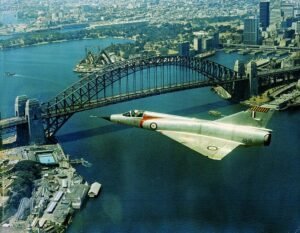
Royal Australian Air Force Dassault Mirage IIIO fighter jet flying over Sydney Harbour

RAAF Mirage IIIO

  The Mirage IIIO was the Royal Australian Air Force’s first supersonic fighter, serving with the RAAF from the delivery of the first aircraft on 9 April 1963 until its retirement in September 1988, when it was replaced by the F/A-18 Hornet.   In the late 1950s, Australia had still not chosen a new fighter to replace the ageing and outdated CA-27 Avon Sabre, an Australian-modified and built version of the American F-86 Sabre. Australia needed a new, modern fighter that was on par with the new NATO fighters of the day. The logic of air defence at the time called for a fast interceptor that could move

Read More
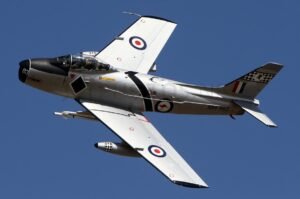
Royal Australian Air Force CA-27 Avon Sabre fighter aircraft in flight

CA-27 Avon Sabre

The Commonwealth Aircraft Corporation ( CAC) CA-27 Avon Sabre was in RAAF service from 1956 to 1971 which was a later start date and a much longer period of service than the American F86 Sabre had. The F86 served with United states from1949 to the late 1950’s even pushing into the early 60’s with some Air national guard units. The Avon Sabre as the Australian variant was known was not the same as the American Sabre. The Commonwealth Aircraft Corporation built it with a Rolls Royce Avon RA.7 turbo jet engine which produced 7 500 pounds of thrust which made it more powerful then the F86 Sabres 6100

Read More