The Commonwealth Aircraft Corporation ( CAC) CA-27 Avon Sabre was in RAAF service from 1956 to 1971 which was a later start date and a much longer period of service than the American F86 Sabre had. The F86 served with United states from1949 to the late 1950’s even pushing into the early 60’s with some Air national guard units.
The Avon Sabre as the Australian variant was known was not the same as the American Sabre. The Commonwealth Aircraft Corporation built it with a Rolls Royce Avon RA.7 turbo jet engine which produced 7 500 pounds of thrust which made it more powerful then the F86 Sabres 6100 pounds of thrust. The larger engine called for a larger intake at the nose and positioning the Avon engine further aft to maintain the new centre of gravity. The Avon had increased fuel capacity than the original F86, a redesigned cockpit layout with mainly British avionics and a Plessey isopropyl nitrate liquid fuel combustion starter which allowed the engine to start without an external power source. It could be scrambled in 150 seconds which means it could sit on the end of a runway all day and be on a two minute standby.
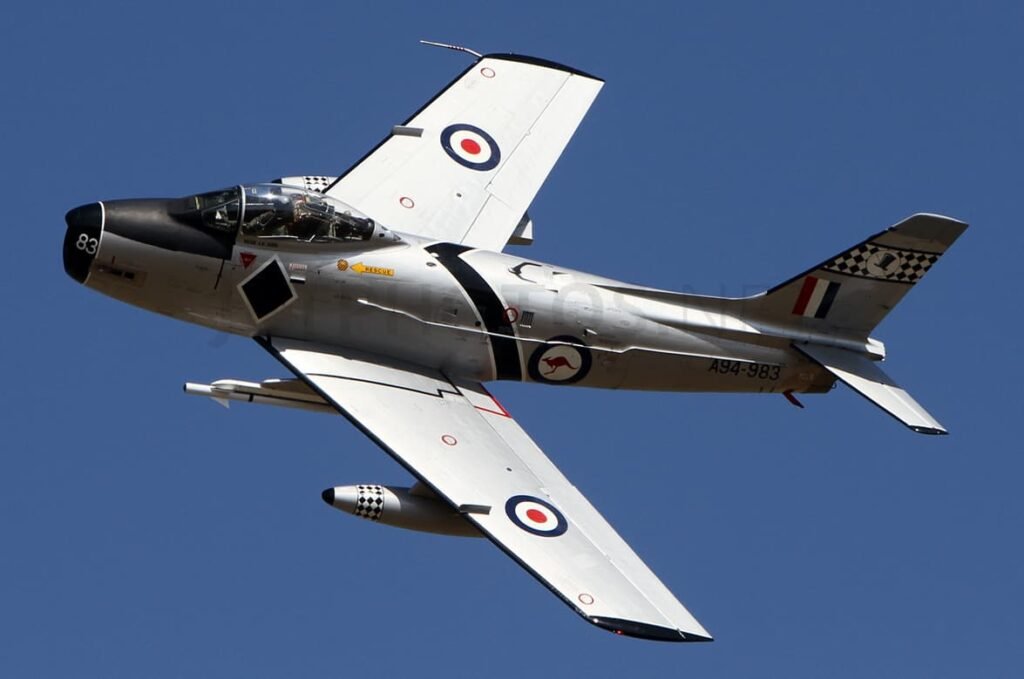
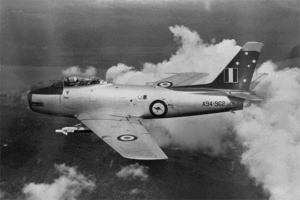
A Royal Australian Air Force CA-27 Avon Sabre in flight. Built in Australia by the Commonwealth Aircraft Corporation, the Avon Sabre was powered by the Rolls-Royce Avon turbojet and served with the RAAF from 1954 to 1971.
The Sabre is the fighter jet of the west that used a swept wing design originally thought of and tested by the Germans during world war two to improve the speed and handling that was limited with straight wing jets of the time.
The guns were changed from six 0.50” machine guns to two 30mm Aden cannons a move that the Americans had made later in their Sabre variants with the fitting of 20mm cannons. The Avon Sabre was considered the best Sabre variant ever made which would have been due to lessons learned from the original F86 Sabres that Australia had the benefit to learn from as they started their production of the Avon Sabres some years after the US had built theirs.
The first test flight of what was known as the CA-26 Avon Sabre was on the 3 August 1953 and this plane was the only CA-26 ever built. The test pilot Bill Scott put the jet into a dive from 42 000 feet and he was the first Australian to break the sound barrier. The first flight of the CA-27 which was the first production model was on 13 July 1954.
In its service life there were three Avon Sabre variants. The Mk 30 of which 22 where built. These had imported Avon engines and leading edge slats. Next came twenty Mk31s that had Australian CAC built engines. The leading edge slats were not a feature of the Mk 31 in favour of an extended leading edge. The choice to move from slats to a fixed extended leading edge on the Avon Sabre came down to simplifying the design and maintenance. Essentially, by using a fixed extended leading edge, they could reduce the complexity of moving parts and make the wing structure a bit more robust. This did reduce the Avons low speed handling but they got sturdier wings while also increasing fuel capacity. All Mk 30s where were later modified to Mk 31s.
The final variant was the Mk 32 of which sixty nine were built. The Mk 32 carried drop tanks and rockets and from 1960 side winder air to air missiles. All earlier Sabres were upgraded to Mk32s
When we compare the F-86 Sabre and its Australian Avon Sabre counterpart, the CA-27 Avon Sabre has a few stand out differences in performance. The Avon Sabre edges out the F-86 with a slightly higher maximum speed of around 700 mph compared to the F86 top speed of 687 mph and a quicker climb rate of about 12,000 feet per minute, compared to the F-86’s roughly 9,000 feet per minute. The Avon Sabre can reach a higher ceiling of about 55,000 feet which is slightly higher than the F-86’s service ceiling of around 49,600 feet.
Both aircraft have similar manoeuvrability, with each capable of handling around 7 to 7.5 G in terms of max G loading and they both carry roughly the same payload of around 5,300 pounds while both turn rates are roughly the same. In summary, the CA-27 Avon Sabre is essentially an enhanced version of the original F-86, offering a bit more speed, a higher operational ceiling, and a quicker climb rate, while maintaining similar handling characteristics.
The Avon Sabre only had two proper operational deployments in its service history. The first was ground attack missions against communist insurgent ground forces during the Malaya emergency operating out of Butterworth
A Royal Australian Air Force CA-27 Avon Sabre in flight. The Australian-built Avon Sabre combined the North American F-86 Sabre airframe with the more powerful Rolls-Royce Avon turbojet, giving the RAAF one of the world’s highest-performing Sabre variants.
The second was in the early stages of the Vietnam war. Aircraft were sent to Ubon Royal Thai Airforce base to provide air defence for the American aircraft that were based there. There were no recorded engagements with enemy forces during this deployment but two aircraft were lost due to accidents.
About 20 aircraft in total were lost due to accidents. This was at a time when aircraft losses were much greater than today. Reasons include pilot error and mechanical failures. Two aircraft were lost over heavily populated suburban areas in Newcastle Australia close to where the aircraft were based. One was due to an ejection the other was an aircraft breakup in the air causing debris to rain down over a shopping precinct down town. The original ejection seat did not have a parachute built into the seat. It was worn by the pilot and strapped to the seat. This meant the pilot had to release themselves from the seat and manually pull the rip cord. It could not be operated below 1300 ft making it useless for an engine failure at take off. Another early issue was when the canopy was released for an ejection it had a tendency to scoop down into the cockpit and hit the pilot which caused a number of fatalities. The issue was solved by developing a canopy breaking spring to shatter the canopy.
Although this Sabre was beginning to be out dated even by the time the Americans had put them into service the Sabre was a great leap forward for the Royal Australian Airforce and the Airforce got the maximum use they could out of them using them to their maximum affect. It really paved the way forward from earlier slower less agile straight wing jets and pushed Australian aircraft manufacturing into a new error which continued right up till the adoption of the F/A18 Hornet that were also built in Australia under licence. Sabres are looked upon with great fondness from aviation enthusiasts as the jet that opened the door to the modern fighters we have today.
Famous American Aircraft F-86 Sabre book on Amazon
A illustrated history of the F-86 Sabre. Includes 500 colour and black and white photos many previously unpublished.