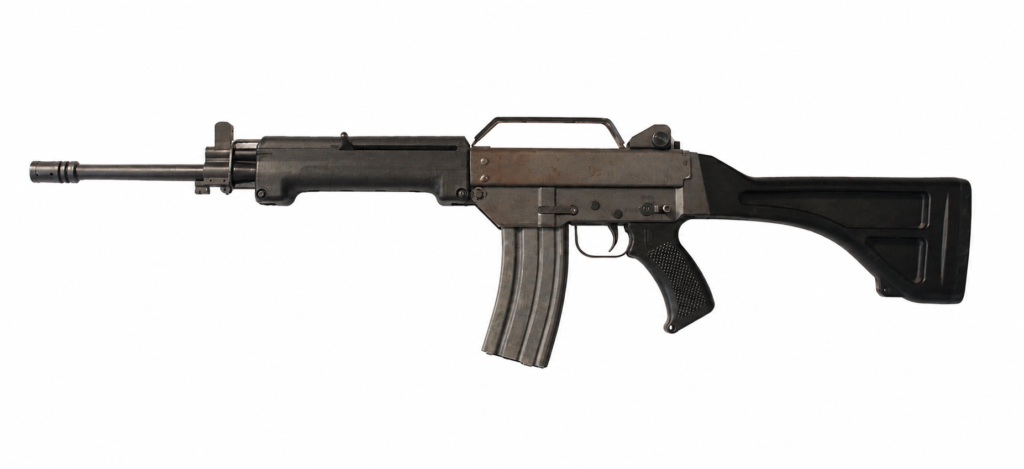
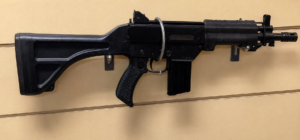
The Australian Automatic Arms SAC and the Leader Dynamics T2 Mk5 rifle have always fascinated me. The SAC is the short carbine version of the SAR, which in turn is a civilian variant of the Leader Dynamics T2 rifle.
I first came across the SAR during a visit to the Lithgow Small Arms Museum some years ago. When I learnt that it was Australian designed and built, it immediately made me ask the question: Why was this rifle never put into service?
It looked fantastic. It seemed like a major leap forward from the L1A1 SLR, and unlike so many rifles appearing around the world at the time, it wasn’t just another M16 clone.
What I was looking at, however, was a rifle built for the civilian market.
The SAC carbine is compact, with a polymer stock, butt and pistol grip. It uses M16-style magazines and, at first glance, looks like a select-fire military carbine that would have been perfectly suited to special forces operating in urban environments.
But appearances can be deceiving.
The SAC, with its 10-inch barrel, and its bigger brother, the 16-inch SAR, were never capable of automatic fire. Both were semi-automatic only because they were designed to be legally sold to civilians.
Enter the Leader Dynamics T2
While the SAC and SAR were never contenders to become Australia’s next service rifle, the Leader Dynamics T2 Mk5 certainly was.
So what exactly was the T2?
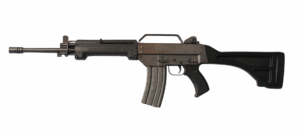
Essentially, it was the original military version of the SAR, complete with select-fire capability, offering both semi-automatic and fully automatic fire. Designed during the late 1970s, it eventually went head-to-head against the F88 Steyr and the M16 during Australia’s search for a replacement for the ageing L1A1 SLR.
Leader Dynamics designed the rifle to be affordable, lightweight and easy to manufacture.
Chambered in the NATO-standard 5.56×45 mm cartridge, the rifle used stamped steel construction rather than expensive machined components. Polymer furniture, developed with assistance from DuPont, kept the rifle light while also reducing manufacturing costs.
One feature I particularly like is the forward-mounted charging handle.
Positioned near the handguard, much like the H&K MP5, it is easier for both right- and left-handed shooters to operate. Left-handed shooters, in particular, can reach it with their right hand without having to reach awkwardly around the rear of the receiver.
Designed for Mass Production
One of the T2’s biggest strengths was its simplicity.
The receiver was manufactured from stamped steel rather than being machined from a solid billet. This meant rifles could be produced faster, with simpler tooling and lower production costs.
From a wartime production perspective, this was a major advantage.
If Australia ever needed to rapidly manufacture thousands of rifles under difficult conditions, the T2 had exactly the sort of design philosophy that had made the Owen submachine gun such a success during the Second World War.
The F88 Trials
The T2 was designed specifically to compete in Australia’s search for a new service rifle.
The replacement for the L1A1 had to pass gruelling trials in all kinds of environments. It needed to be reliable, accurate, easy to operate, simple to strip and maintain, and capable of allowing ordinary soldiers to consistently hit man-sized targets out to around 300 metres.
Another important requirement was Australian manufacture.
The M16 could not meet this requirement because an acceptable local production agreement could not be reached.
Steyr, on the other hand, was prepared to license production and provide the machinery, technical support and training needed for Lithgow to manufacture the F88 in Australia.
Leader Dynamics, despite having an Australian-designed rifle, faced a different problem.
The company simply wasn’t large enough to convince the government that it could manufacture, support and supply rifles in the numbers the Army required.
The T2’s Shortcomings
Although the rifle showed plenty of promise, it still had a number of shortcomings during testing.
The handguard became uncomfortably hot during sustained firing.
The magazine well was very tight, making magazine changes slower than they should have been.
The flash suppressor was also criticised for doing a poor job of reducing muzzle flash.
One thing I have noticed, however, is that every modern video I’ve watched of surviving T2 rifles shows them functioning reliably. I’ve yet to see one jam or suffer a feeding problem.
Of course, these are modern civilian shooting demonstrations on clean ranges, so they don’t necessarily tell us how the rifle would have performed under harsh military conditions.
Why the Steyr Won
The T2’s sights were generally considered good.
A rotating rear sight allowed elevation adjustments for 100, 200 and 300 metres.
However, the F88 Steyr offered something that immediately gave it a major advantage—a low-powered optical sight.
Iron sights inevitably obscure part of the target. A scope allows the shooter to keep the entire target and surrounding area in view.
For engagements inside 300 metres, simply placing the reticle on the target made accurate shooting easier, especially for inexperienced soldiers.
The Steyr was also straightforward to learn.
With relatively little training, most soldiers could quickly become proficient with it.
Just as importantly, Steyr could provide Australia with everything needed to establish local production at Lithgow.
Could It Have Been Different?
When the T2 entered the trials, it was still essentially a prototype.
It clearly needed further development.
Unfortunately, time was not on its side.
I’ve often wondered whether things might have been different if the rifle had appeared twenty years earlier.
Perhaps the Australian Government would have invested in its development, refining the design into a truly world-class service rifle.
Had that happened, the Leader Dynamics T2 might today be remembered alongside the Owen gun as another great Australian-designed military firearm.
Instead, its main historical claim is being Australia’s first indigenous gas-operated military rifle design.
From Military Rifle to Civilian Sporting Rifle
Once Leader Dynamics lost any realistic chance of securing a military contract, the company eventually collapsed.
The rifle design was acquired by Australian Automatic Arms, who adapted it into the semi-automatic SAC and SAR for the civilian market.
Several changes were made.
The most obvious was the removal of the carry handle, which had always been regarded as somewhat flimsy and easily damaged.
The rifles enjoyed some success with civilian shooters.
However, following Australia’s firearms law changes in the late 1990s, which effectively removed most semi-automatic rifles from the general civilian market, demand disappeared.
Without a viable market, Australian Automatic Arms eventually closed its doors.
Final Thoughts
I still find the T2 one of the most interesting firearms ever designed in Australia.
It wasn’t perfect.
It probably wasn’t ready to beat the Steyr when the trials were held.
But it was Australian.
It was innovative.
And with more time and development, I can’t help wondering whether it might have become one of Australia’s great military firearms instead of becoming one of its great “what if”.
If you want to see a great video on the M2 Mk5 watch this link below.