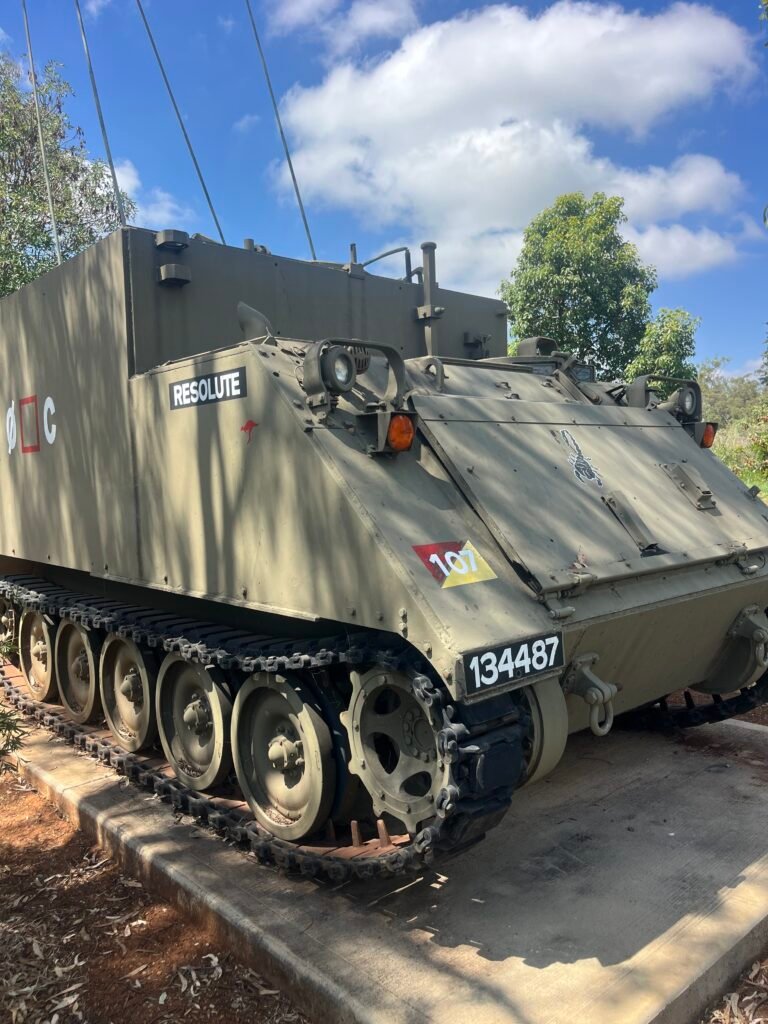
The M577A1 Armoured Command Vehicle (ACV) is a variant of the M113 Armoured Personnel Carrier, which was built by the American Food Machinery Corporation and first delivered to Australia in 1965.
Both the M113 APC and the M577 ACV were found to be susceptible to landmines during the Vietnam War. As a result, Australian vehicles received an armour upgrade, with additional aluminium armour fitted to the lower sections and underside of the hull to improve protection.
A Mobile Command Centre
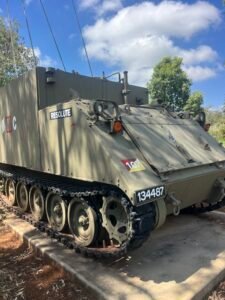
The M577A1 was based on the standard M113 APC but featured a raised roof and extended hull sides, providing considerably more working room inside the vehicle.
It carried an external power unit in a cradle mounted on the front of the raised hull. This unit could be removed and placed on the ground to provide power for the vehicle’s electrical and communications equipment while the M577A1 was stationary and its main engine was switched off.
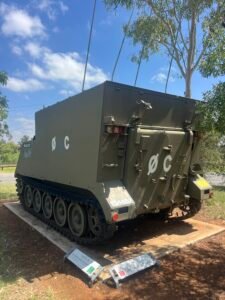
The vehicle also featured a tent extension that could be erected at the rear, significantly increasing the available working area when operating as a static command post.
The Australian M577A1
The Australian Army version of the M577A1 differed from its American counterpart in several important ways.
One of the biggest differences was the engine. While early American vehicles were originally powered by petrol engines, the Australian version was powered by the GM 6V-53 Detroit Diesel engine.
Australia’s decision to use this engine provided several advantages. The engine was already being used in other Australian military equipment, making the training of maintenance personnel easier while also providing greater commonality of spare parts.
Diesel fuel also presents less of a fire hazard than petrol—an important consideration for an armoured vehicle designed to operate in combat.
The M113 family of vehicles became affectionately known as “buckets” within the Australian Army, a nickname that has continued to be associated with them over the years. These vehicles were designed to provide their crews and passengers with protection from small-arms fire and shell fragments, but operating on the battlefield inevitably meant that damage could occur.
Keeping the Crew Comfortable
Another difference was the inclusion of a ventilation system in Australian vehicles to improve crew comfort.
It was certainly not air conditioning, but the ventilation system helped make working inside these armoured “buckets” a little more bearable, particularly in the hot and humid climate encountered during operations in Vietnam.
Communications on the Battlefield
The final major difference was the radio equipment.
Australian M577s carried a mixture of American and British radio equipment to assist interoperability with allied forces. As the M577 was designed to operate as a mobile command centre, having the best available communications equipment was essential.
A mobile command centre provides commanders with a protected platform from which battlefield information can be collected, assessed and acted upon. From inside the vehicle, commanders and their staff could coordinate the movement of troops and equipment, issue orders and respond to a constantly changing battlefield situation.
A good example of the importance of battlefield communications can be seen during the Battles of Coral and Balmoral in the Vietnam War. Command vehicles such as the M577 helped provide the communications needed to collect battlefield information and coordinate orders between artillery batteries, troops in contact and supporting air assets.
Firepower
For self-defence, both the M113 and M577A1 could be fitted with a mounted .30-calibre M1919 machine gun.
However, because the M577A1 was primarily a command vehicle and was not intended to engage the enemy in the same way as an M113 APC, M60 general-purpose machine guns were also commonly used for local protection.
The real strength of the M577A1 was not its firepower. Its purpose was to provide commanders and their staff with a mobile, protected headquarters capable of keeping pace with forces operating in the field.
A Long Career with the Australian Army
The M113 family, including the M577 command vehicle, remained in Australian Army service well into the 2000s and underwent major rebuilds and upgrades as their service lives were extended.
However, the old “buckets” are now approaching the end of their long careers with the Australian Army as newer armoured vehicles enter service.
Modern platforms such as the ASLAV and the German-designed, Australian-built Boxer Combat Reconnaissance Vehicle offer significantly greater firepower, mobility and crew protection.
The old buckets have served Australia well, but their protection was designed primarily around the battlefield threats of an earlier era, particularly small-arms fire and shell fragments. Modern warfare presents increasingly serious threats from improvised explosive devices, anti-armour weapons and, more recently, drones.
Despite their limitations, the M113 family and the M577A1 Armoured Command Vehicle have had remarkably long careers in Australian service. For decades, these vehicles provided Australian soldiers and commanders with mobility, protection and, in the case of the M577A1, a vital command-and-control capability on the battlefield.
The old buckets may finally be nearing the end of their service, but they have certainly earned their place in Australian military history.
Author: Daniel Harper
M113 APC: US, ARVN and Australian variants in Vietnam book on Amazon
This new fully illustrated study examines the service record of the M113 from its initial fielding through to the end of the Vietnam War.
As an Amazon Associate Khaki and Green earns from qualifying purchases