After a robbery of several handguns from the Lithgow Small Arms Museum, the museum’s weapons display has been closed to the public. If you had been there a few years ago, you would have seen the best display of firearms in the country.
A 30‑minute drive from Katoomba in the Blue Mountains, just west of Sydney, brings you to Lithgow, the home of the Lithgow Small Arms Museum. The museum is located on Methven Street in a late‑1950s‑style building that looks like it may have been the old main office of the Small Arms Factory (SAF). Contained within these walls was, without a doubt, the best collection of firearms in the country, far outdoing the National War Memorial in Canberra and the School of Infantry in Singleton. It was an amazing display of not only Australian military history but also firearms from foreign nations and civilian manufacturers, with examples dating back to before World War One.
When you walk down the hallway, you are confronted with large, poster‑sized pictures on the wall of SAF in its heyday. They show people working long assembly lines and belt‑driven lathes connected to steam‑powered drive shafts running the full length of the factory ceiling, giving you a great insight into just how long this place has been operating.
Construction of the Lithgow Small Arms Factory began in 1909. Before this time, Australia was militarily supplied by England, and after Federation a strategic decision was made to build a facility to produce its own armaments. The town of Lithgow was chosen because it was far enough inland to be out of range of naval bombardment, and it already had a steelworks, a large coal supply, and a rail line to Sydney. The factory opened in June 1912, and the first 40 Lee‑Enfield Mk III .303 rifles were produced by May 1913, with production rising during World War I to 1,600 rifles per week. Throughout the 1930s, extensions were made to the factory to produce the Vickers machine gun and the Bren light machine gun. At the height of World War II, the factory was producing 4,000 .303s, 150 Brens, and 50 Vickers guns per week.
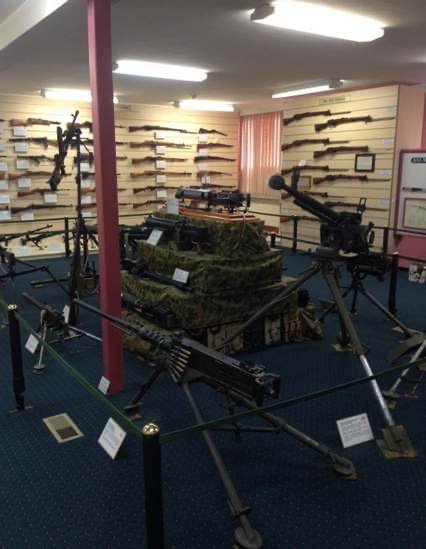
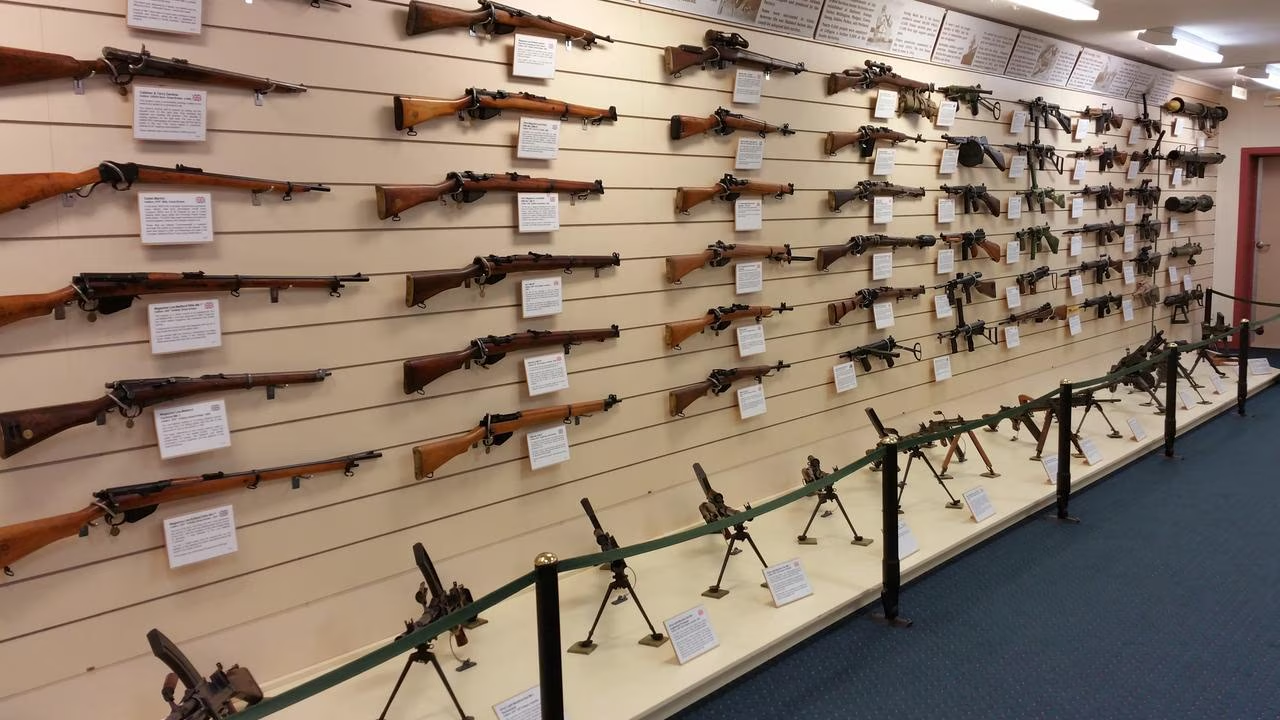
The museum was split into three display rooms. The first one, downstairs, contained a truly amazing display of rifles and machine guns, from the Martini .310 Cadet to a Browning M1 .50‑calibre heavy machine gun. There was a gun rack with an Owen submachine gun, a .303, an L1A1 SLR, and an F88 Steyr that you could pick up and play with as you wanted. All of them had fully working parts, and it was the highlight of the museum for kids both old and young. There was also a Vickers machine gun in the corner with a sandbag wall around it that the kids could play with too.
Also in this room were some very rare rifles, including the E2 7mm Enfield bullpup. This rifle was trialled by the British in an attempt to replace the .303 with a new semi‑automatic rifle.
You could view excellent examples of every variant of .303s and SLRs ever made, including a trial .303 with a stock made of Bakelite. Every variant of Steyr was on display, and there were skeletonised versions of every firearm that has served with the Australian Army, allowing you to get a good look at the working parts. There were examples of so many weapons from foreign countries that I couldn’t mention them all, as well as civilian rifles built at SAF for companies such as Slazenger.
Upstairs was a room containing the best display of handguns in the country. This room was full of glass display cases with everything from old cap‑and‑ball revolvers to the .50‑calibre Desert Eagle. You could see a Micro Uzi, the Smith & Wesson S&W 500 revolver, and some of the most ornate 1911s and 9mm Browning Hi‑Powers I have ever seen. I don’t know how many handguns were in this room, but I would guess 300 or more, so you can just imagine the diverse examples on display.
Author: Daniel Harper